

Chinese Painting
The history of Chinese painting can be compared to a symphony. The styles and traditions in figure, landscape, and bird-and-flower painting have formed themes that continue to blend to this day into a single piece of music. Painters through the ages have made up this “orchestra,” composing and performing many movements and variations within this tradition.
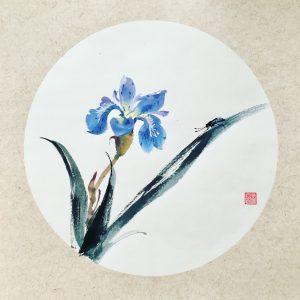
Chinese Flower Painting
Flowers are like emissaries of beauty, greeting viewers with their myriad forms and colors. Indeed, the splendor they bring to Nature moves the hearts of people everywhere. For this reason, artists and writers all over the world have been attracted to flowers down to the present day, leaving behind many equally beautiful masterpieces. In China’s earliest collection of poems and songs, The Book of Poetry (詩經), flowers often serve as metaphors for beauty. For example, “The peach tree is young and elegant (桃之夭夭)” uses the beautiful imagery of delicate peach blossoms to express the joy of a young maiden who has newly wed. “With a countenance like the (ephemeral) hedge-tree flower (顏如舜華)” refers to the varied colors of a plant known in ancient times as the hedge-tree (nowadays called the Rose of Sharon 木槿, or Hibiscus syriacus) to describe the beauty of a girl. Such descriptions reveal the ancients’ level of observation regarding flowers some three millennia ago.
Over the course of Chinese painting, the three main subjects have been landscapes, birds-and-flowers, and figures. Flowers, a major subcategory in the bird-and-flower genre, became the object of attention and depiction by painters throughout the ages. Artists not only directly portrayed the outer beauty of flowers, they also expressed the subtle spirit and demeanor of their subject. Painters went even further to imbue blossoms with deeper meaning, transforming them into objects for lodging feelings. As the Ming dynasty author Wang Xiangjin (王象晉) wrote in Record of All (Flowers) Fragrant (群芳譜), “I try to observe the morning flowers putting on their splendor, competing in all their great beauty and fragrance. Some keep company with others as they grow, while others go against time and show their preciousness. Despite their great floral beauty and exotic nature, such myriad manifestations are not easy to grasp. Their flourishing stems bloom and wither, also bringing joy and sorrow. Who says that such lodgings of joy and pleasantries of the heart are unrelated to the emotions and character?”
The themes presented below are from a special exhibition at the National Palace Museum in Taipei. There are four sections: “Beautiful Scenes All Year Round,” “Formal Expressions of the Mind,” “Their Many Features in Painting,” and “Auspicious Signs and Lucky Omens.” Flowers blooming throughout the year have been chosen to express their relation to the seasons and certain festivals in China. These artworks also demonstrate how artists used their skill of compositional arrangement and such basic techniques as ink outlines filled with colors (雙鉤填彩), “boneless” washes (沒骨), fine ink lines (白描), and freehand “sketching ideas” (寫意) to transform apparently simple subjects into a wide variety of forms and manners in keeping with the times. The interpretation of auspicious metaphors in paintings also reveals how artists portrayed blossoms from yet another point of view, allowing viewers to further appreciate the unique beauty and diversity of flower painting.
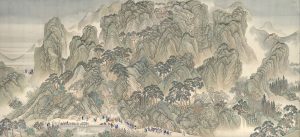
Chinese Landscape Painting
By the late Tang dynasty, landscape painting had evolved into an independent genre that embodied the universal longing of cultivated men to escape their quotidian world to commune with nature. Such images might also convey specific social, philosophical, or political convictions. As the Tang dynasty disintegrated, the concept of withdrawal into the natural world became a major thematic focus of poets and painters. Faced with the failure of the human order, learned men sought permanence within the natural world, retreating into the mountains to find a sanctuary from the chaos of dynastic collapse.
During the early Song dynasty, visions of the natural hierarchy became metaphors for the well-regulated state. At the same time, images of the private retreat proliferated among a new class of scholar-officials. These men extolled the virtues of self-cultivation—often in response to political setbacks or career disappointments—and asserted their identity as literati through poetry, calligraphy, and a new style of painting that employed calligraphic brushwork for self-expressive ends. The monochrome images of old trees, bamboo, rocks, and retirement retreats created by these scholar-artists became emblems of their character and spirit.
Under the Mongol Yuan dynasty, when many educated Chinese were barred from government service, the model of the Song literati retreat evolved into a full-blown alternative culture as this disenfranchised elite transformed their estates into sites for literary gatherings and other cultural pursuits. These gatherings were frequently commemorated in paintings that, rather than presenting a realistic depiction of an actual place, conveyed the shared cultural ideals of a reclusive world through a symbolic shorthand in which a villa might be represented by a humble thatched hut. Because a man’s studio or garden could be viewed as an extension of himself, paintings of such places often served to express the values of their owner.
The Yuan dynasty also witnessed the burgeoning of a second kind of cultivated landscape, the “mind landscape,” which embodied both learned references to the styles of earlier masters and, through calligraphic brushwork, the inner spirit of the artist. Going beyond representation, scholar-artists imbued their paintings with personal feelings. By evoking select antique styles, they could also identify themselves with the values associated with the old masters. Painting was no longer about the description of the visible world; it became a means of conveying the inner landscape of the artist’s heart and mind.
During the Ming dynasty, when native Chinese rule was restored, court artists produced conservative images that revived the Song metaphor for the state as a well-ordered imperial garden, while literati painters pursued self-expressive goals through the stylistic language of Yuan scholar-artists. Shen Zhou (1427–1509), the patriarch of the Wu school of painting centered in the cosmopolitan city of Suzhou, and his preeminent follower Wen Zhengming (1470–1559) exemplified Ming literati ideals. Both men chose to reside at home rather than follow official careers, devoting themselves to self-cultivation through a lifetime spent reinterpreting the styles of Yuan scholar-painters.
Morally charged images of reclusion remained a potent political symbol during the early years of the Manchu Qing dynasty, a period in which many Ming loyalists lived in self-enforced retirement. Often lacking access to important collections of old masters, loyalist artists drew inspiration from the natural beauty of the local scenery.
Images of nature have remained a potent source of inspiration for artists down to the present day. While the Chinese landscape has been transformed by millennia of human occupation, Chinese artistic expression has also been deeply imprinted with images of the natural world. Viewing Chinese landscape paintings, it is clear that Chinese depictions of nature are seldom mere representations of the external world. Rather, they are expressions of the mind and heart of the individual artists—cultivated landscapes that embody the culture and cultivation of their masters.
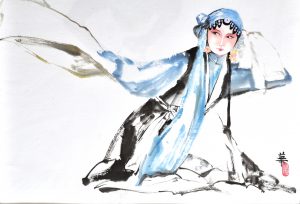
Chinese Figure Painting
When most westerners think of Chinese painting, they do not tend to think of figure painting. Landscapes of lofty hills or birds and flowers in the spring are familiar and resonate more readily with similar themes in western art. Those subjects are more culturally neutral, perhaps more universal, than figure paintings. Most of us need to feel a connection as individuals or representatives of a heritage with the people depicted in figure paintings in order to appreciate them fully.
Having acknowledged the relative unfamiliarity of figure painting to western viewers of Chinese art and so that we may more fully appreciate this unique genre, let us take a brief look at the history of Chinese figure painting.
Figure painting in China appeared in the Neolithic era, first on pottery, then on tiles, tomb and cave walls, and in family shrines. Landscape and Bird/flower painting came much later. The primary function of figure painting was transmission of moral and ethical principles. Paintings illustrated the Taoist search for nature, Buddhist reach for nirvana or Confucian counsel for filial piety. Temple scenes or quiet natural retreats provided settings for these illustrations. One of the earliest examples of Confucian teaching is “Admonition of Court Ladies” by Ku Kai-chih (344-405). This handscroll , now in the British Museum, is a series of courtyard scenes depicting young ladies learning about proper deportment. One of the inscriptions read, “People know how to improve their visage, but not how to improve their character.” It accompanies carefully drawn figures, draperies folding and stretching to indicate the posture of each person.
Times change, social and historical events became primary reasons for figure painting. Tang Dynasty court painters such as Yen Li-pen (died in 673), who painted the “Thirteen Emperors” and Chang Hsian, “Ladies Weaving Newly Prepared Silk,” are represented in the Boston Museum. Chou Fang’s “Tuning the Flute and Drinking Tea” (second half of the 8th century) is another dignified, elegant illustration of the life of the powerful and privileged. On all these examples, colors and refined lines delineate facial expressions, body movement and gestures. “Tuning the Flute” is at the Palace Museum in Taiwan.
Figure painting lost its momentum with the rise of landscape painting toward the end of the Tang Dynasty. Academy painters and the literati considered landscape painting the height of achievement. Li Kung-lin (1040-1106 ) was one of the few scholars who continued Ku Kai-chih’s tradition. He was a Confucian gentleman who venerated the past but used his heritage to meet the popular demands of his time. He was known for his paintings of horses and humans portrayed with dignity and spirit. Li created the Pai Miao style (pure line drawing) for figures. His technique has been widely favored by artists since. It uses fine lines and no shadows, merging almost indistinguishably with calligraphy, (see “Chinese Figure Painting” by Tom Lawton, FREER GALLERY OF ART.)
At the peak of Li’s dominance in traditional figure painting in the twelfth and early thirteenth century a freshness entered. Chan (Zen) artists created a new style. Sudden inspiration and spontaneity were valued. Chan artists painted lohans, poets, monks and illustrated Chan stories with broad strokes, tremulous lines and dashing monochrome ink washes. “The Sixth Patriarch Tearing Up a Sutra”, painted by Liang Kai (mid 13th century), portrays the bald sixth patriarch ripping a sutra to show that Chan believers do not need written words. The brushwork is impetuous and quick.. The patriarch is calling out in ecstasy and his message is certainly clear. Chan painting came and went quickly. Literati artists considered the style too undisciplined and unorthodox. However, this spontaneity and spirit have had a lasting influence and it has continued to impact artists ever since.
A revival of traditional figure painting after decades of decline developed during the Ming Dynasty. Chou Chen (c1500-1535 ), Chang Lu (c1490-1563) , and Tang Yin (1470-1523)were scholar-amateur artists who painted individual scholar/officials or ordinary people instead of groups of people as described in earlier periods. Literati artists were independent painters. To respond to the demands of a broader audience, professional artists appeared. Chiu Ying, a landscape artist (c1495-1552) was also especially skillful at painting beautiful women. In “Spring Morning in Han Palace,” now in the Palace Museum in Taiwan, Chiu depicts dancing, playing, portrait painting and other daily activities in the beautiful palace (See “Possessing the Past” by Wen Fang and James Watt.) His techniques are almost exactly like those of the Tang artists we have mentioned, but faces are thinner, there is more variety and color in draperies, and backgrounds are more elaborate. Chiu had a number of followers. One of them was his daughter, Chiu Chu (see “Mother and Children” in our collection.) Chen Hung-shou (1598-1652) was a later artist whose painting kept the continuity of figure painting. His “Viewing a Painting” is also in this exhibit. In different ways these Ming artists played important roles in the restoration of classical painting.
In the Ching dynasty (1644-1911) figure painting continued but did not flourish. Literati and court artists only half-heartedly depicted the human figure. Some followed Chiu Ying’s style to illustrate novels, but portrayed slim, listless women to meet the demand for commercial portraits. Court painters engaged in painting Emperors journeying to the south. Along the Grand Canal north of the Yangtzu River “the eight eccentrics” in Yang Chou were changing this direction. Huang Shen (1687-1768) used unorthodox brushwork which contrasted sharply with the detailed portrayals of figures current in his generation. One can safely say that these artists were playing with ink, expressing the spirit of subjects rather than careful, fastidious rendering. In the early years of this century artists in the Shanghai School created their own styles, reinterpreting eccentric figure painting.
After 1949 Socialist realism was promoted and the traditional literati forms were discouraged. Soldiers, workers, laboring women and children became a new didactic style. This style is still current, but people on the mainland are now free to choose among many styles. Currently the China Academy of Fine Arts in Hang Chou has undertaken to build the new Che School of Literati Figure Painting in order to keep the tradition alive and well. Wu Shan-ming’s portrait of a lady and Tong Chen-kuo’s “Chess Players” in this exhibit are examples of this trend. This exhibition shows many styles, delivering many different messages, all serving to keep memories of human history alive.